





New research from Professor John Jerrim at UCL and ImpactEd Group brings something important into focus. When secondary girls' peer relationships drop to very low levels, their unauthorised absences rise sharply. For boys, and for girls at average or strong peer relationships, the link is much weaker. It is the bottom tail of the distribution that matters, and it is girls where the risk concentrates.
John's analysis focuses on the 2024/25 academic year. We wanted to know whether the pattern he identified was still visible in the most recent TEP data. Looking at our national benchmarks across 2025/26, the gender gap he describes is still there, in every census window, across every secondary year group.
What the paper found
John's research uses pupil-level TEP data from the 2024/25 academic year, covering 112,629 pupils across 129 schools. It links each pupil's engagement responses across three termly census points with their authorised and unauthorised absence rates, controlling for prior attainment, demographics and school. It is the most detailed investigation of gender differences in peer relationships and attendance to date.
Three findings stand out:
- Peer relationships decline as the school year progresses, for both boys and girls. The steepest fall is between autumn and spring terms.
- Girls consistently report lower peer relationship scores than boys. By summer, 34% of girls and 30% of boys scored at or below 5 on the peer relationships scale, up from 27% and 23% in the autumn.
- In secondary schools, poor peer relationships are linked to higher unauthorised absence rates, particularly amongst girls. The link is non-linear. Very low peer relationships substantially increase absence risk, while moving from average to high-quality peer relationships makes little further difference.
The non-linear finding matters
That third finding is the one that matters most in practice. It tells us that lifting peer relationships from average to excellent does not reliably reduce absences. The risk sits at the bottom of the distribution. For secondary girls, it is those with very poor peer relationships who miss school, not those in the middle.
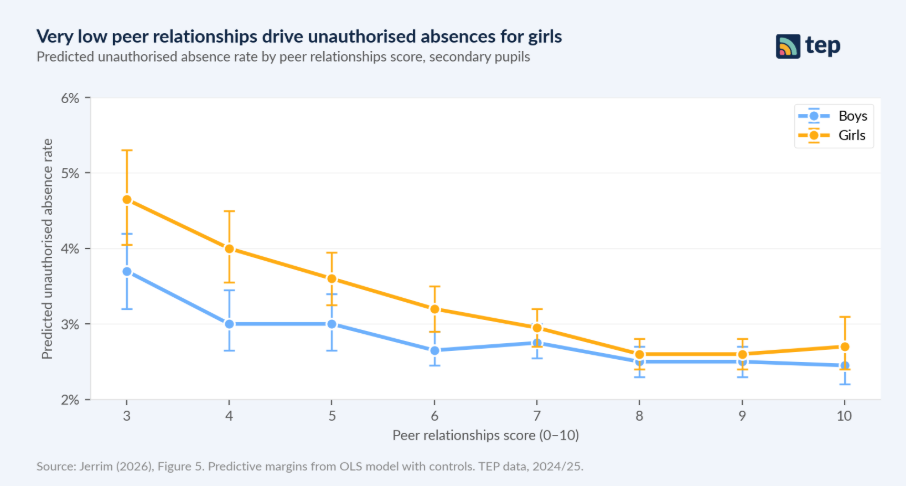
Figure 1. Predicted unauthorised absence rate by peer relationships score, secondary pupils, by gender.
Reading the chart from left to right, predicted unauthorised absences for secondary girls fall steeply between very low peer relationship scores (3 and below) and average ones (around 7 to 8), then flatten out. The girls' line sits above the boys' line throughout, with the gap widest at the bottom of the scale. For boys, the gradient is shallower and the lines come together at higher scores.
The implication is concrete. Whole-cohort interventions aimed at improving peer relationships generally are unlikely to shift attendance much. Targeted support for the girls whose peer relationship scores are lowest, at the point they fall, is the intervention that maps onto the evidence.
The pattern is still there in 2025/26
John's analysis captures 2024/25 at pupil level. Our national benchmarks are school-level, but they extend the view across four census windows from spring 2024/25 through to spring 2025/26. If the pattern he identified had softened, narrowed or shifted in the subsequent academic year, we would see it. We don't.
Across every secondary census term, girls report lower peer relationships than boys by around 0.4 points on the 0 to 10 scale. The gap is present in every year group from Y7 to Y11. It is stable, wide, and visible term after term. The research is not describing a 2024/25 phenomenon. It is describing a current one.
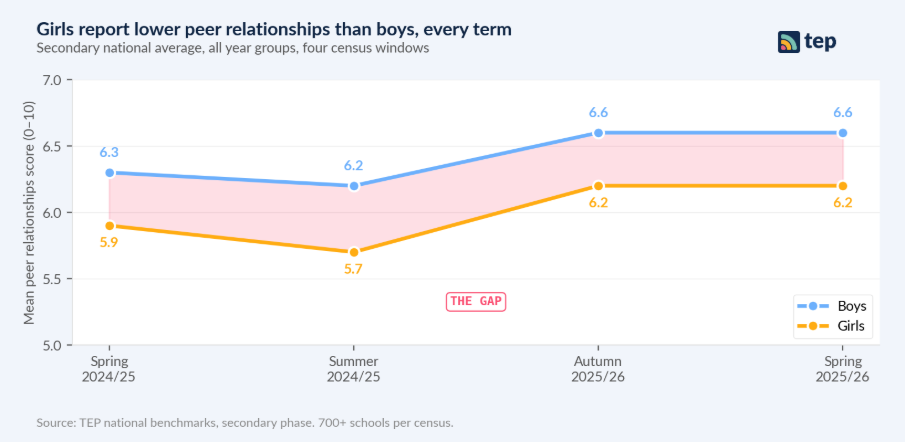
Figure 2. Secondary national average peer relationships score by gender, four census windows.
The decline across secondary year groups is equally visible in the national data. In spring 2025/26, average peer relationship scores fell steadily across the secondary phase: Y7 6.8, Y8 6.3, Y9 6.2, Y10 6.0, Y11 6.0. Whatever is producing this decline is structural, not incidental.
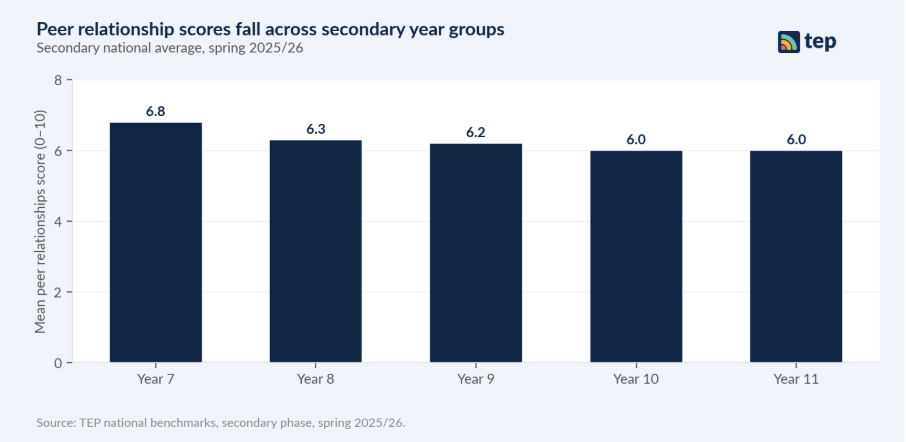
Figure 3. Secondary national average peer relationships score by year group, spring 2025/26.
Primary looks different
The most striking piece of context our national data adds is this. At primary level, there is essentially no gender gap on peer relationships. In spring 2025/26, primary girls averaged 7.6 and primary boys 7.7. Across all four census terms at primary, girls score in line with boys, sometimes marginally higher.
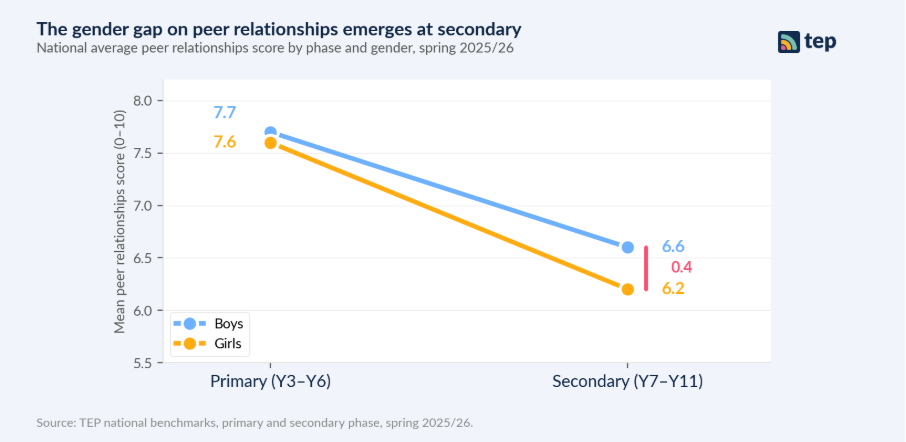
Figure 4. National average peer relationships score by phase and gender, spring 2025/26.
The gender gap on peer relationships is not something girls bring with them from primary school. It emerges at secondary, and it persists across every year group of secondary schooling. That is a developmental pattern, and it matches John's pupil-level finding about where the risk concentrates.
What this means for schools
Engagement shifts before attendance does. You have a window.
This research underlines a point we see repeatedly in the national data. Attendance is a lagging indicator. By the time absence shows up in the register, the underlying drivers have usually been moving for some time. Peer relationships are one of the clearest leading signals we see.
For secondary schools specifically, the evidence supports a precision approach rather than a whole-cohort one. Identifying the girls whose peer relationship scores have fallen into the bottom tail, and supporting them early, is where the research points. Universal 'peer relationship' programmes are unlikely to meaningfully shift attendance, because the risk is concentrated, not distributed.
This is why termly engagement measurement, with consistent benchmarking, matters. Annual surveys or aggregate cohort summaries cannot tell you which pupils are sitting in the bottom tail right now, and they cannot tell you whether a score of 5 for your Y9 girls is unusually low or typical for that year group nationally. Precision benchmarking does both.
Read the full paper
John Jerrim's paper, Gender differences in peer relationships and their link with absences from school, is available in full here. It is a careful, rigorous piece of work that contributes something important to the conversation about attendance and engagement. We are proud that TEP engagement data made the study possible.