





Engagement is in the White Paper. Here's What It Means for the Decisions You've Already Made.
Last month, the Government published Every Child Achieving and Thriving - its most significant statement on school improvement in years. Chapter 4 is titled 'Withdrawn to Engaging'. That framing alone tells you something has shifted in how national policy thinks about schools.
For school and trust leaders, the White Paper lands at an already demanding moment. You are navigating attendance challenges, staffing pressures, and the expectation to deliver more - often with the same resource. The last thing most people need is another framework to implement by 2029.
So I want to be direct about what this means, and what it doesn't.
What the White Paper actually says about engagement
The White Paper sets a clear expectation: by 2029, every school in England should be monitoring pupils' sense of belonging and engagement. The DfE will publish a new Pupil Engagement Framework later this year - a standard set of questions, developed with schools, to help measure the factors that matter most.
This is a significant shift. It signals that engagement is no longer a 'nice to have' sitting alongside attainment data. The Education Secretary said it plainly at the CST conference last autumn: "Engagement seeps away. Attendance follows. You know the rest."
That line stuck with many of us because it is not a new idea - it is something schools have known for a long time. What's new is that national policy is now catching up.
What this means for decisions you have already made
If you have invested in understanding pupil engagement - through TEP, through pupil voice activities, through the kind of careful work we have seen from trusts in our research community - the White Paper validates that instinct. It does not ask you to start again.
For trust leaders who are already using engagement data, the question shifts from 'should we be doing this?' to 'how do we use what we already know more effectively?' That is a much better problem to have.
Engagement data doesn't tell you what to do. It tells you where to look - and gives you the confidence to act on what you find.
If you are not yet measuring engagement in a structured way, the White Paper gives you both the mandate and the runway. Three years is enough time to build something meaningful - but only if you start with a tool that produces data you can actually trust and act on. The DfE's own framework will provide a foundation. What it cannot provide, by design, is the contextual benchmarking that tells you whether what you are seeing is specific to your school, or common across the sector.
The benchmarking question
This is the part that matters most for leaders trying to make decisions under uncertainty - and where I want to be specific about what makes one approach different from another.
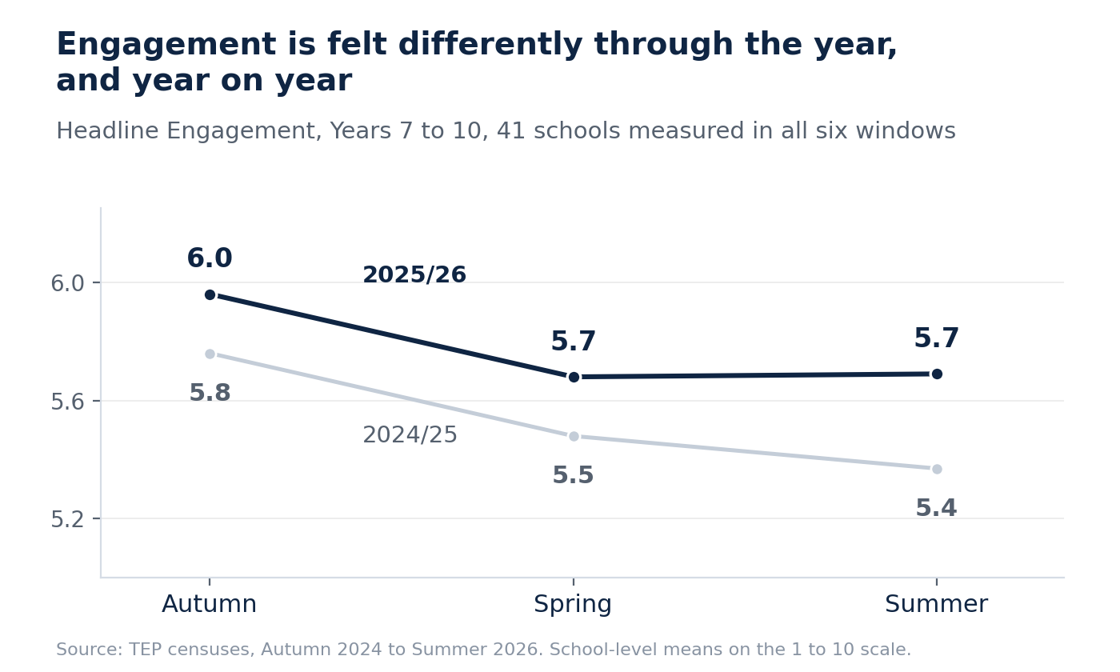
TEP runs three census windows each academic year. In each single window, over 300,000 pupils are answering the same questions at the same moment in time. That matters more than it might first appear. Because engagement is seasonal - it moves within the year, not just across years - you can only compare schools fairly if you are comparing them against others who surveyed at the same point in the calendar. Autumn scores sit consistently above Spring scores. A school that surveys in October and benchmarks against data collected in March is not comparing like with like.
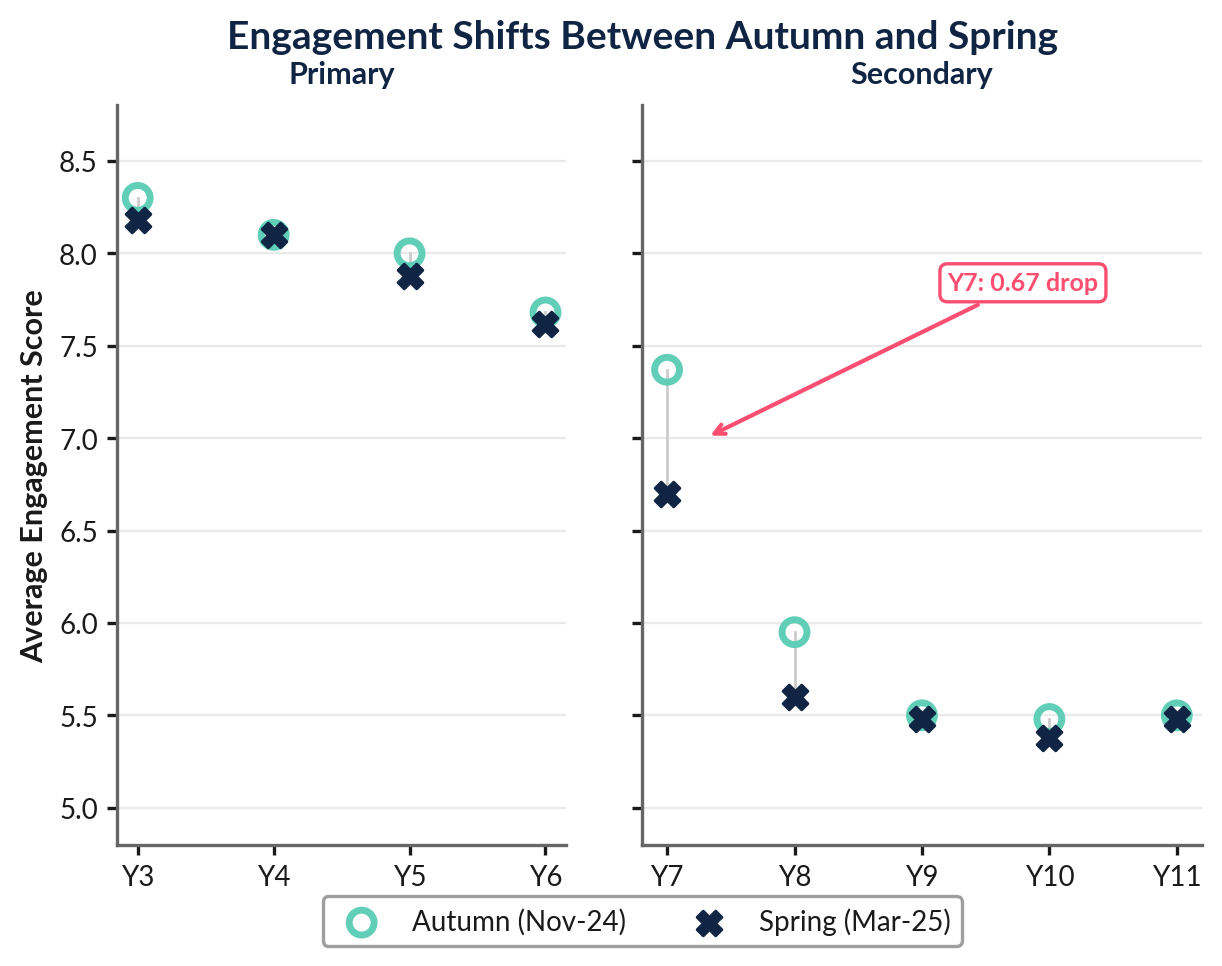
What three annual windows gives us is something closer to a live picture. We can see, for example, not just that Year 7 engagement drops across the secondary journey, but when within Year 7 that drop is steepest - and which groups of pupils are moving furthest. That is a different kind of insight from an annual average, and it supports a different kind of leadership response.
But the more important point is about contextualisation. Knowing your overall school engagement score is useful. Knowing how your Year 8 boys eligible for free school meals compare to all Year 8 boys eligible for free school meals nationally - that is where local school improvement actually starts. That is the question a head of year or a pastoral lead can act on. It is specific enough to prompt a conversation, design a response, and track whether it is working.
Any tool that brings more schools into the habit of measuring engagement is a good thing. The question every leader should ask is: what can I actually do with this data? A benchmark built from hundreds of thousands of pupils responding at the same moment, broken down by year group, gender, FSM status, and SEN - compared against schools with a similar profile to yours - gives you a different starting point than a washed-together national average. Not better in an abstract sense, but more useful for the decisions you actually need to make.
300,000 pupils in a single census window. Three windows a year. That is not a technical detail - it is what makes the benchmarks precise enough to act on.
What the data tells us - and what it doesn't
One thing we have been clear about throughout the development of TEP is that engagement data guides decisions; it doesn't make them. A trust leader reviewing TEP data after an Autumn census is not being told to run a particular intervention. They are being shown where their Year 8 girls' Safety scores have dropped relative to comparable schools, and given the confidence to ask why - and to design something that fits their context.
This distinction matters because the White Paper - quite rightly - does not prescribe what schools should do in response to engagement data. It sets the expectation that schools should know. The professional judgement of school and trust leaders remains central. What good data does is improve the quality of that judgement.
The best school leaders we work with don't use engagement data to confirm what they already believe. They use it to challenge their assumptions and focus their energy where it will have the greatest impact.
We have seen this play out directly. Wade Deacon High School, one of the first trusts to join our Research Commission, discovered they were bucking the national Year 7 trend - not a result they expected, and not one they would have known without the benchmarking to compare against. That finding prompted them to ask harder questions about what they were doing, and how to sustain it. The data was the beginning of the conversation, not the end of it.
The employee engagement piece
One area the White Paper addresses - increasing teacher recruitment and retention - connects directly to something our own evidence base has been building for several years.
Staff engagement is not a separate issue from pupil engagement. Our data shows that employee engagement explains 35% of the variation in pupil engagement - a figure that rivals school demographics as a predictor. Two schools can serve near-identical communities; the one with more engaged staff will almost always have more engaged pupils.
The White Paper's ambition to recruit 6,500 more teachers is welcome. But recruitment without retention is a revolving door. Our research has consistently found that the single strongest predictor of whether a teacher stays is not workload or pay - it is whether they believe in the direction the school is heading. Buy-in to leadership strategy is more predictive of retention intent than any other workplace factor we measure.
If you are a CEO or headteacher thinking about how to respond to the White Paper's staffing ambitions, measuring and understanding employee engagement is one of the highest-leverage actions available to you. Not because it solves recruitment, but because it surfaces the conditions that determine whether good staff stay.
What we are doing about it
TEP's work was cited in the White Paper itself - a recognition we are genuinely proud of, and which reflects the contribution of every school and trust that has been part of our research community. But we are more focused on what comes next than on the citation.
The DfE will publish a Pupil Engagement Framework later this year. We are committed to ensuring TEP's validated question set aligns with that framework - so that schools working with us are not starting from scratch, and are already well ahead of the 2029 expectation. We will share more detail on this as the framework develops.
What we are not doing is waiting for 2029. The schools that will be best placed to respond to the national expectation are the ones building genuine capability now - not just collecting data, but using it to improve the experience of every pupil, every member of staff, and every family that walks through their doors.
The schools that build genuine engagement capability now won't just meet the 2029 expectation. They will be ahead of it - with the evidence to show what works.
A final thought
The White Paper sets a national expectation. What it cannot do is tell you what that looks like in your school, for your pupils, in your community. That knowledge belongs to you - and to the staff and young people around you.
Good engagement data doesn't replace that knowledge. It extends it. It gives you the confidence to act early, to be deliberate, and to know when something is working.
If you would like to talk about what this means for your school or trust, or to understand what our data shows at a national level, we would love to hear from you.