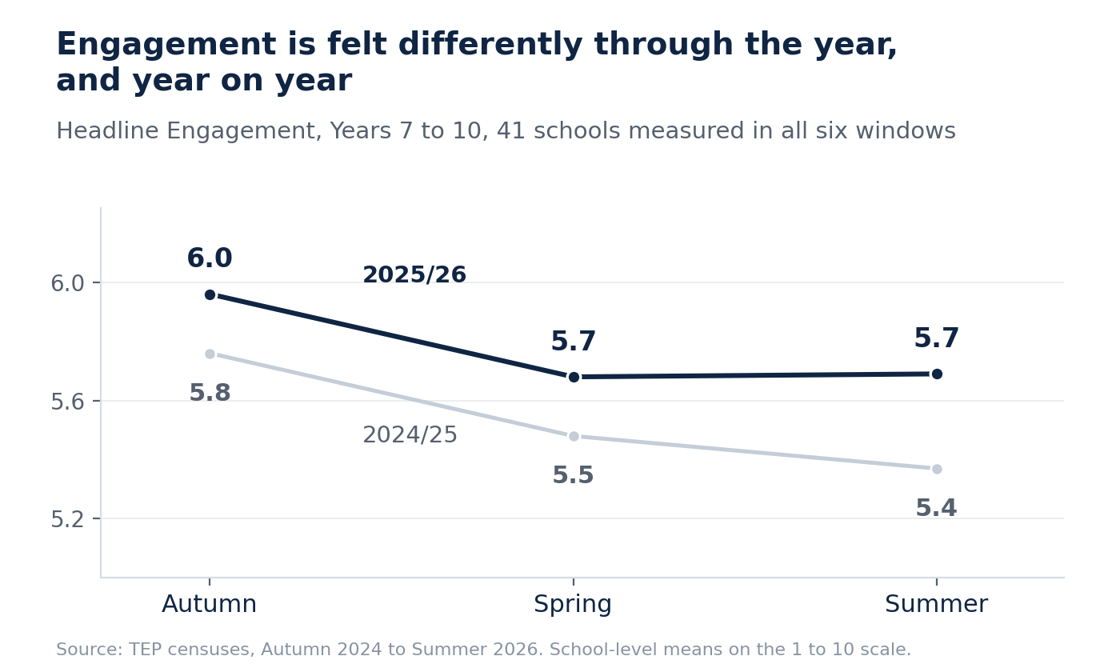





Pupils in coastal secondary schools report levels of overall engagement comparable to those elsewhere in England. However, analysis of six terms of data from The Engagement Platform (TEP) reveals important differences beneath this headline measure, particularly in pupils' sense of belonging, the perceived value of learning and patterns of engagement during the transition to secondary school.
At primary level, the findings are more positive, with coastal pupils reporting stronger relationships and a greater sense of safety. Together, these patterns raise important questions about how engagement develops across different phases of education and the factors that may influence pupils' experiences in coastal communities.
Pupil engagement has become an increasingly prominent focus of national education policy. The February 2026 Schools White Paper refers to engagement approximately 80 times and sets out an ambition for all schools to measure pupil engagement and belonging by 2029. The paper also introduces Mission Coastal, recognising the relationship between geographical disadvantage, educational opportunity and outcomes.
This provides an important context for examining engagement in coastal schools. National evidence suggests that, despite serving broadly comparable proportions of disadvantaged pupils, coastal schools experience lower rates of pupil progress than schools elsewhere in England.
In conversations with coastal school leaders and regional education partners, several recurring challenges emerge, including transport and accessibility, geographical isolation, access to wider educational and employment opportunities, and workforce recruitment and retention.
Our analysis explores whether these wider contextual challenges are reflected in pupils' engagement with school, and where differences emerge when coastal schools are compared with schools elsewhere in England.
About the analysis
The Engagement Platform (TEP) measures pupil engagement through three national census windows each academic year, in November, March and June. Using a consistent, validated framework and the same questions at each census point enables schools to examine changes over time and compare their results with national and contextual benchmarks.
Our framework examines three dimensions of engagement:
- Cognitive engagement: How pupils think about school, including their sense of agency, motivation and the value they place on learning.
- Emotional engagement: How pupils feel about school, including belonging, inclusion, enjoyment and relationships with peers and teachers.
- Behavioural engagement: How pupils report engaging with learning through their effort
These dimensions are measured through eleven engagement drivers, each scored on a scale of 0–10.
The analysis draws on six terms of TEP census data, from Autumn 2024/25 to Summer 2025/26. Coastal schools were compared both with schools elsewhere in England and with schools serving similar demographics.
Finding 1: Overall engagement is comparable atsecondary, but coastal pupils report lower engagement across the underlying drivers
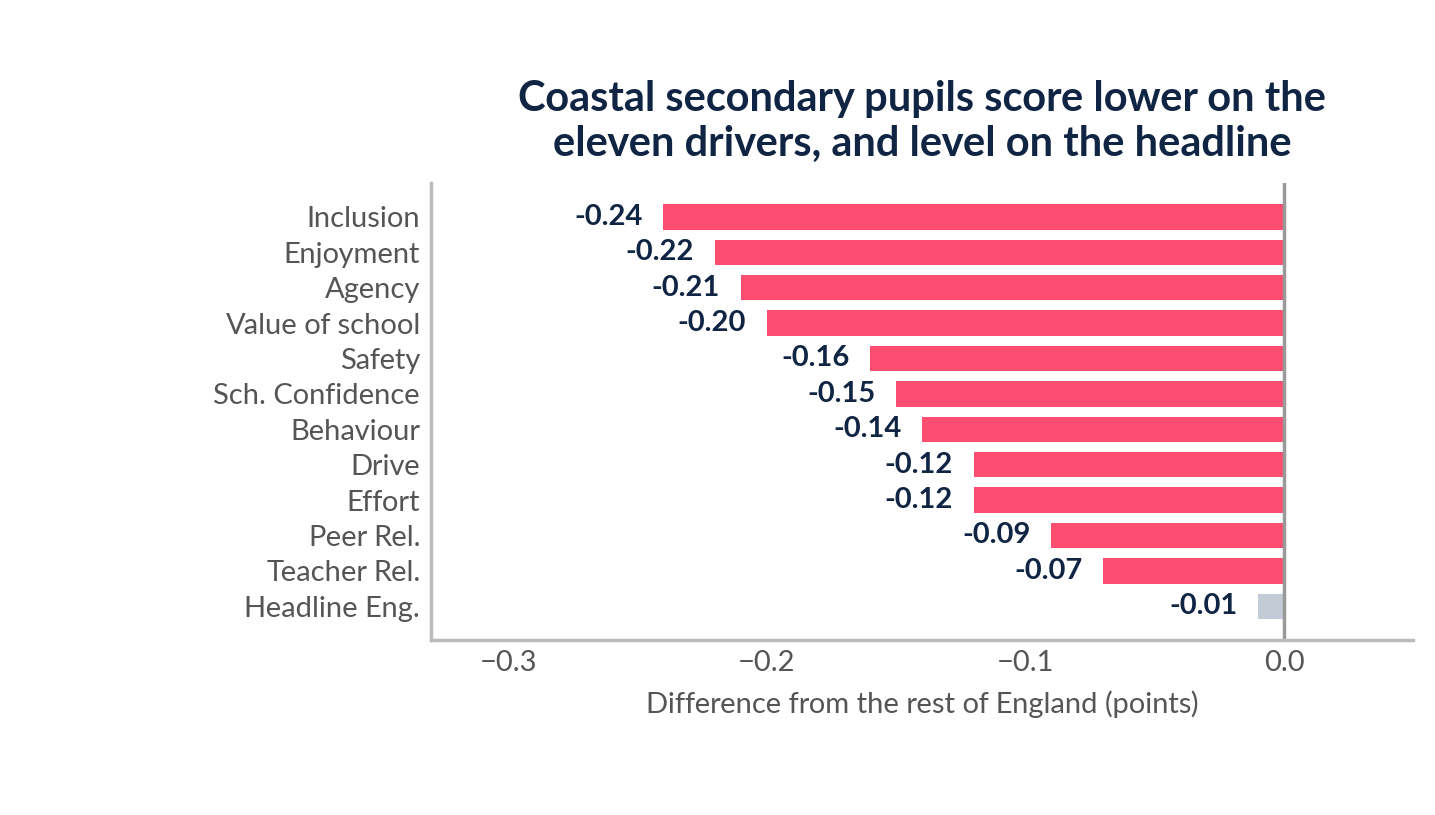
At secondary level, Headline Engagement is almost identical between coastal schools and those elsewhere in England, at 6.01 and 6.02 respectively. However, examining the individual engagement drivers reveals a more consistent difference.
Coastal secondary pupils report lower scores across all eleven drivers, with gaps ranging from 0.07 to 0.24 points, the largest differences are observed in Inclusion and Enjoyment.
These differences are not explained entirely by pupil disadvantage. When compared with secondary schools serving similar proportions of FSM-eligible pupils, coastal schools continue to report lower engagement across nine of the eleven drivers.
This highlights the importance of examining the underlying dimensions of engagement rather than relying exclusively on a headline measure. Similar overall engagement scores can conceal meaningful differences in how pupils experience school.
Finding 2: Coastal primary pupils report stronger relationships and safety, but lower levels of effort
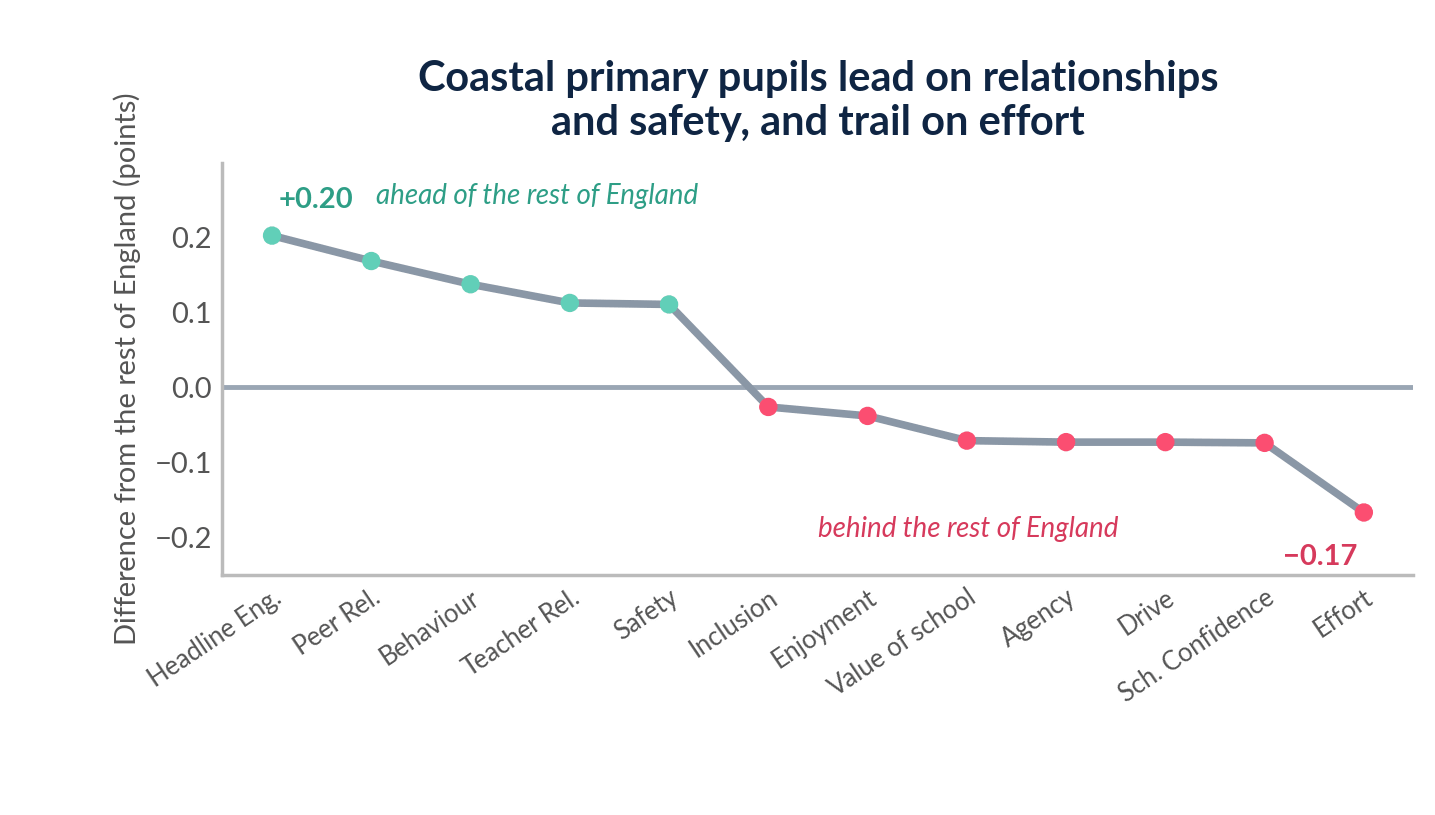
The picture at primary level is notably different. Coastal primary schools report higher Headline Engagement than schools elsewhere in England, scoring 7.88 compared with 7.67. This positive difference remains when coastal schools are compared with schools serving similar intakes.
Coastal primary pupils also report stronger engagement across several important drivers, particularly Peer Relationships, Teacher Relationships,Behaviour and Safety.
These findings suggest that relationships and school environments are relative strengths within the coastal primary sample. However, Effort presents a different pattern. Coastal primary pupils score 0.17 points lower on this measure than pupils elsewhere in England.
Understanding how these dimensions interact may therefore be particularly valuable, especially as pupils prepare for the transition to secondary education.
Finding 3: Coastal pupils enter secondary school with higher engagement, but experience a steeper decline
One of the most consistent patterns in TEP's national data is the decline in engagement during the transition from primary to secondary education.
Although engagement decreases gradually throughout primary school, the decline becomes substantially more pronounced during Year 7 and into Year 8. Nationally, this transition accounts for approximately three-quarters of the decline in engagement observed across secondary education, with levels remaining comparatively low throughout Key Stage 4.
For coastal schools, this pattern is particularly significant.
In Autumn 2025/26, coastal Year 7 pupils reported Headline Engagement of 7.65, compared with 7.34 elsewhere in England.
Despite entering secondary education with higher reported engagement, the subsequent decline is steeper. The difference between Year 7 and Year 8scores is 1.49 points in coastal schools, compared with 1.29 points elsewhere. A similar pattern is observed in the Spring and Summer census windows.
The findings suggest that the challenge is not necessarily lower engagement on entry to secondary school, but the extent to which engagement is sustained thereafter.
Geographical context may be relevant. Coastal secondary schools are three to six times more likely to be located at a considerable distance from a major town, often serving wider geographical catchments. Longer journeys, changes in peer networks and differences in access to school-based opportunities may contribute to pupils' experiences of transition. However, further analysis is needed to establish the extent to which these factors explain the observed differences.
The findings reinforce the importance of understanding transition as a sustained process rather than an event concentrated around the start of Year 7.

Finding 4: Coastal secondary pupils report comparable overall engagement, but are less positive about belonging and the future value of learning
A closer examination of individual survey questions provides further insight into the differences observed at secondary level.
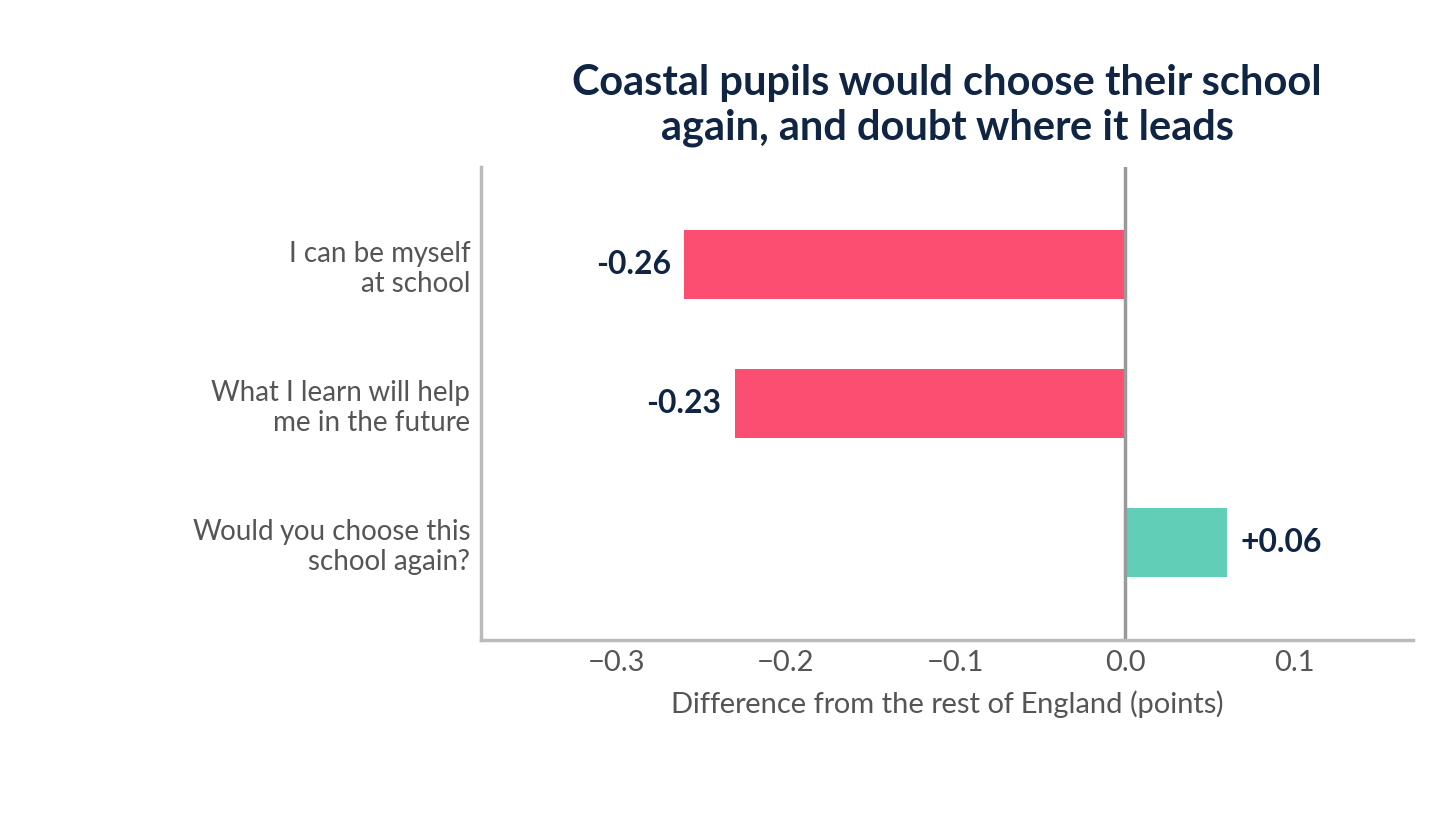
Across approximately forty questions, coastal secondary pupils score higher than their peers elsewhere in England on just one: "Would you choose this school again?", where the respective scores are 6.09 and 6.03.
However, two of the largest differences concern pupils' sense of belonging and their perceptions of the future relevance of learning. Coastal pupils report lower agreement with statements about being able to be themselves at school and believing that what they learn will help them in the future.
These findings suggest an important distinction between pupils' overall engagement with their school and specific aspects of their educational experience. In particular, the difference in how pupils perceive the future value of learning warrants further attention in the context of coastal communities, where access to employment pathways, further education and wider opportunities can vary considerably.
While the data cannot establish whether these contextual factors directly explain the differences, it raises questions about how pupils understand the relationship between their education and future opportunities.
The findings also demonstrate the additional insight gained through question-level analysis. Headline Engagement alone would not identify these differences in belonging and perceived educational value.
Finding 5: A coastal primary case study demonstrates substantial improvement relative to similar schools
Although the wider findings identify consistent differences in engagement, school-level analysis also demonstrates that these patterns are not fixed. One coastal primary school provides an example of substantial improvement across an academic year.
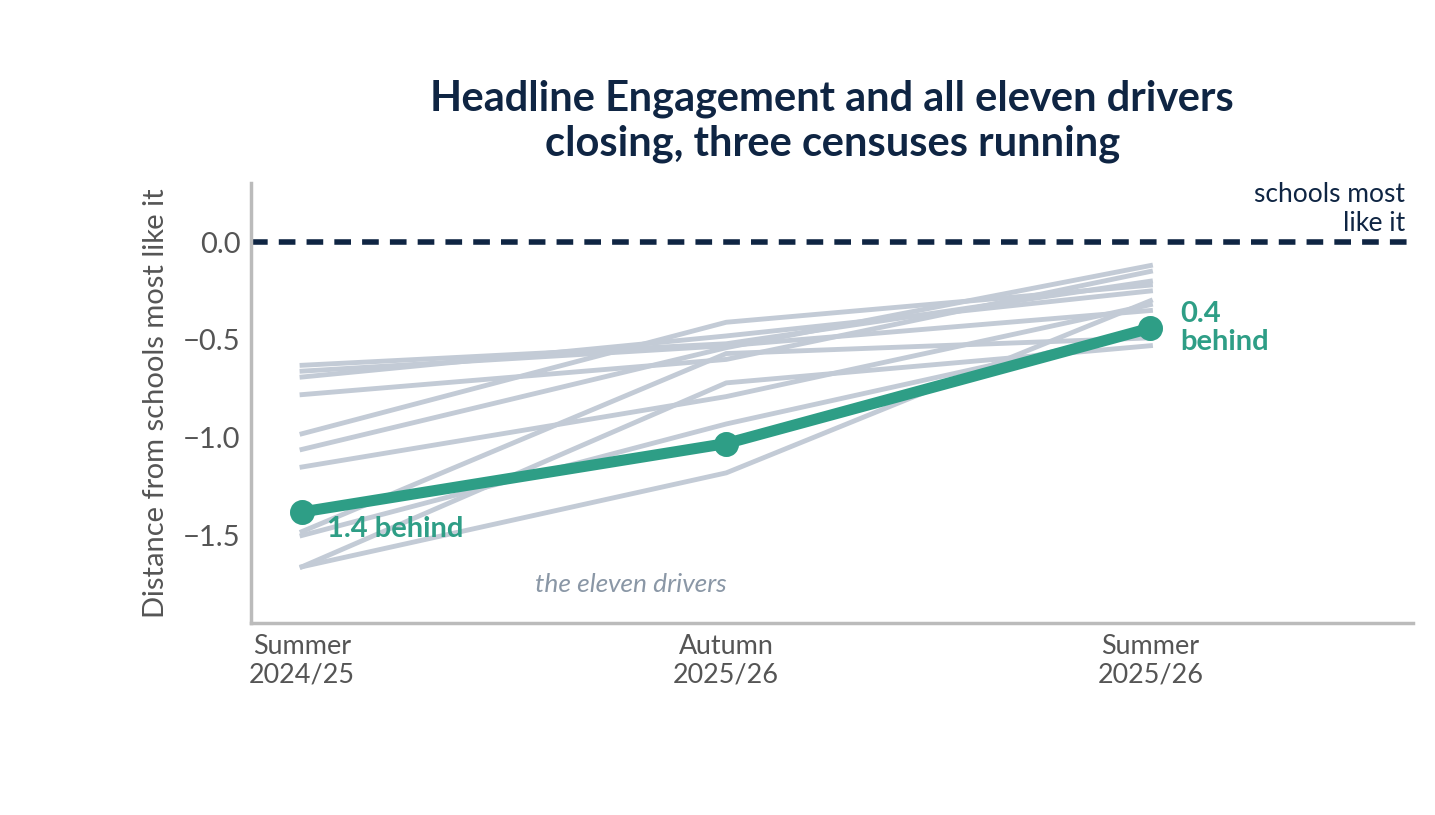
The school serves a particularly challenging context, with approximately three-quarters of pupils identified as FSM6 and one-third receiving SEN Support. Across three consecutive census windows, the school improved its position relative to schools serving similar intakes on Headline Engagement and all eleven underlying engagement drivers.
Most notably, the gap in Headline Engagement narrowed from 1.4 points below its contextual benchmark to 0.4 points below. Because each census compares the school with similar schools measured at the same point in the academic year, these improvements cannot be explained simply by the seasonal variation typically observed in engagement. Although the school's engagementscores remain below those of its contextual peers, the reduction in the gap is substantial and consistent across the framework.
The findings do not, on their own, establish which school-level actions contributed to this improvement. However, they demonstrate the value of longitudinal measurement in identifying changes that may otherwise be difficult to recognise.
They also illustrate why contextual benchmarking matters. Comparing schools only with a national average risks overlooking meaningful progress made in settings serving significantly different pupil populations.
What do these findings mean for coastal schools?
Taken together, the findings present a more nuanced picture of engagement in coastal schools than headline measures alone suggest.
At primary level, coastal pupils report comparatively strong relationships, positive perceptions of safety and higher overall engagement. At secondary, overall engagement is comparable with the national picture, but important differences emerge in belonging, inclusion, enjoyment and the perceived future value of learning. Perhaps most significantly, coastal pupils enter secondary education with relatively high engagement, but experience a steeper subsequent decline.
These findings do not suggest that coastal schools are less effective. Rather, they identify specific dimensions of pupils' engagement that may warrant closer attention, particularly in the context of the geographical and socioeconomic challenges facing coastal communities.
They also reinforce the value of examining engagement alongside existing evidence on attendance, attainment, behaviour and inclusion. Engagement data can offer additional insight into pupils' experiences and potentially identify emerging differences before they become evident in other outcomes.
The findings align with priorities identified by coastal education leaders and organisations such as the Colyton Foundation, particularly around disadvantage, aspirations, and access to wider opportunities.
For coastal schools in particular, longitudinal engagement data offers an opportunity to move beyond broad measures of educational disadvantage and develop a more detailed understanding of pupils' experiences, the challenges they encounter and where targeted support may be most valuable.
Explore the findings further
If you would like to discuss the analysis or explore how engagement data could support your school or trust, please contact me at engagement@tep.uk.
Coastal schools are currently eligible for a 40% subsidy to join The Engagement Platform.